
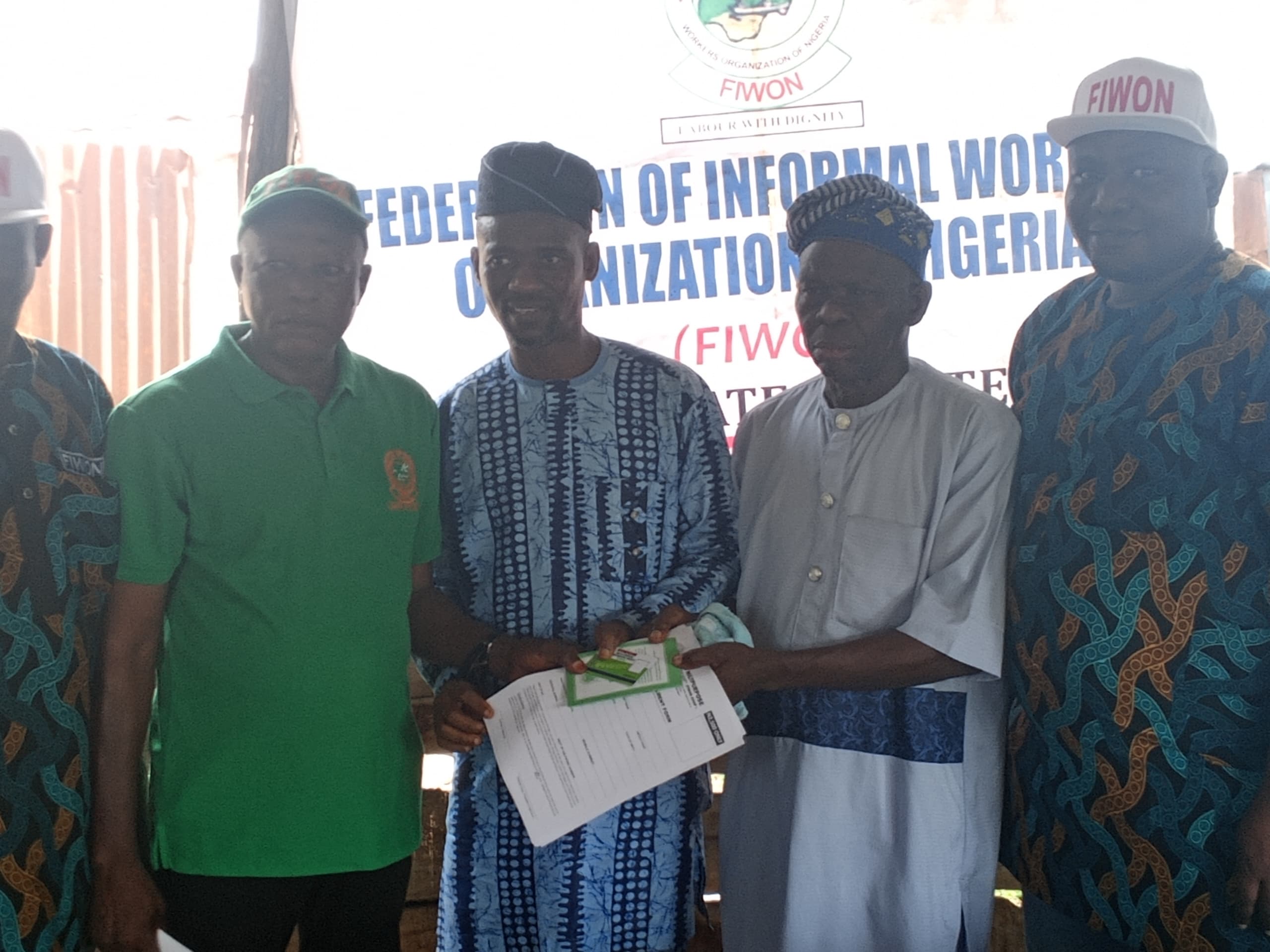
- Mechanic Village, Bódìjà, Ojurin, Ìbàdàn
- 4 November 2026
- Balogun Hairat interviewing Comrade Ibrahim Olayinka
Access to credits is a major challenge for the informal sector, most especially traders. So, in trying to solve this problem, FIWON is trying to provide financial services to our members as part of the effort of the organization to solve the problem of finances and access to credits to our members. So, we have, over a couple of years, a functional cooperative aimed towards supporting members. This has been providing financial services to a lot of our members over the years. But we find out that cooperative is also inadequate, because despite the presence of the FIWON cooperative, a lot of our members still rely on LAPO and several other microfinance and even the conventional bank for credits. The challenges of credit facilities is ever present with them all the time. So, but we found out that instead of this credit to solve their problem, most often, they end up indebted to this financial institutions. Our research has also shown that most of these traders don't even know, specifically, the terms of some of these credits they are taking. Some charge as much as 50 percent interest rate, some charge 60 percent, and some like 40 percent. So, we looked at this, where there are complaints, and FIWON decided to commence our own direct financial support through the FIWON Credit Scheme, that is geared towards alleviating these challenges of inadequate and inaccessible and very expensive credits that are being provided by conventional financial institutions. Because we don’t have the money, we are in partnership with a microfinance bank in Lagos, a faith-based microfinance bank, Buwe microfinance bank. So, with the negotiation and a lot of effort, they are able to reduce the normal interest rate, because they believe that through an organization, the recovery rate is 100 percent. So, we negotiated a very small interest rate, which is 20 percent. Our repayment period is four months—16 weeks— because it is a weekly payment schedule. After completing the form, you start. For the first loan, it's just 100,000 Naira. When you complete repaying that 100,000 Naira, if your business improves and you need an additional loan, you can take 200,000 naira or 300,000 Naira up to 1 million Naira as time goes on. But before then, we should have at least known that you and your business. It's only a member that can access the credit line, but the cluster leaders, which is like a community of members that remit regularly, one can pick up the application form, complete the application, the leader in that cluster must assent to that form before it gets processed. So, once it gets processed, within 24 hours, you receive a credit alert. We also encourage all our members to have a functional bank account. All members, no one can access this credit line without a functional bank account. It is a requirement. We also use the opportunity of the credit facility to train members on financial literacy. We train them on basic principles of record keeping, how to manage their business appropriately, planning, and other relevant basic financial literacy that can sustain their businesses. Also, as part of the scheme, we have incorporated health insurance. Any member who wants to apply for the loan must have it in mind. Either you have a functional health insurance, you have an insurance enrollee, you must have enrolled on a health insurance. If you are not enrolled, FIWON will provide the credit line for you to enroll. The logic behind this is that when somebody repaying a loan falls sick, they will not be able to do any business, and will not be able to pay. We find out that simple things that could have been taken care of with health insurance are not taken care of. So, we make sure as part of the conditions, you must also be part of health insurance. It is not that you have to pay a separate fee for the insurance. We add the health insurance premium with the FIWON credit scheme. You pay your premium, you get registered, you get the services—which is one year before you have to repay. So, for example, the health insurance premium in Oyo State, which we launched last time, is 18,000 Naira. FIWON negotiated 18,000 Naira, it's 22,000 Naira. However, because of the group solidarity, for our members, we negotiated 18,000 Naira with the agency—the Oyo State Health Insurance Agency. So, we pay for the enrollees, which are also loan applicants, and we convert it as a part of the loan. For example, if somebody is taking a 100,000 Naira loan, we add 18,000 Naira to the 100,000 Naira for the health insurance. So, for a first-timer, 18,000 Naira will be added. So, they are paying the 100,000 Naira, and also paying that 18,000 Naira, while they are benefiting from the health insurance immediately, because once there is an agreement to fill their form, the process commences immediately. Under a week or two, he or she has their health insurance card, which covers for a whole year. So, just an arrangement, that will just be paying like 101,000 and something every week for four months. So, to complete the health insurance money, which is added to the loan, which is the minimum, the starting point is a flat rate of 100,000 Naira for every person. The repayment period is four months. Once you complete that four months, or if you finish repaying before the end of four months, you can pick up another form and increase from 100,000 Naira to 200,000 Naira or 300,000 Naira, but you still have an existing health insurance that is functioning for that period of time. So, it's a whole package. We educate members on financial literacy, how to sustain their business, how to be profitable with their business, and how to cut their expenses. Then, we also take care of their health needs.
Labour